
Small Batch Sauce Subscription Box Review: Top Picks
Table of Contents
- Why a Small Batch Sauce Subscription Box Changes Your Cooking
- How We Reviewed These Small Batch Sauce Boxes
- Hot & Spicy: Best for Heat Seekers
- Drizzle & Drip: Best for Finishing Oils and Vinegars
- Chef's Companion: Best for Full Pantry Staples
- The Foodie Sampler: Best for Trying Before Committing
- Best Artisan Food Subscription Boxes 2026: Comparison Table
- Gourmet Hot Sauce of the Month Club: What to Expect
- Frequently Asked Questions
Last Updated: September 12, 2026
Why a Small Batch Sauce Subscription Box Changes Your Cooking
A small batch sauce subscription box is a recurring delivery of limited-run sauces, oils, and condiments from independent producers, usually in batches too small for grocery distribution. This guide from Foodie Box Love breaks down what separates a good box from an overpriced one in 2026.
The appeal is access. Small-batch makers work with specific chili pepper varieties, aged vinegars, and fermented pepper mash that never reach supermarket shelves because the volume isn't there. A subscription puts those bottles in your hands without hunting through farmers markets.
How We Reviewed These Small Batch Sauce Boxes
Most "best sauce subscription" roundups are written from a press release and a product photo. We treated each box as a six-month test, because the real questions, Do you finish the bottles? Does the curation repeat? Does the value hold up in month five?, only surface after the novelty wears off.
Our Testing Protocol
Every box was scored 1-5 per shipment across six weighted criteria, averaged over the review period:
- Ingredient sourcing transparency, Does the box name the producer, region, and specific ingredient (a named chili variety, a single-origin olive oil), or hide behind vague terms like "artisan blend"?
- Price per usable ounce, Total box price divided by the net weight of every included item, excluding samples. The most useful number for comparing boxes of different sizes.
- Variety and progression, Does the curation build a palate (vinegar-based → fermented → smoky) or just ship three unrelated hot sauces?
- Shipping frequency flexibility, Can you switch between monthly and quarterly without penalty? Is pausing allowed?
- Cancellation and billing clarity, How many clicks to cancel? Is the renewal date stated up front?
- Packaging and shipping durability, Did any glass arrive chipped? How much void fill was used per bottle?
What We Tracked Over Six Months
For each delivery, we logged:

- Days to finish each bottle, a proxy for real-world usefulness. A finishing oil untouched for three weeks is a value problem, not a quality problem.
- Repeat flavors, how often the same producer or sauce type reappeared.
- Recipe card usage, whether the recipes were actually cooked, not just filed away.
- Cost per meal touched, total subscription cost divided by meals where at least one box item was used.
Why We Weight Curation Over Packaging
A common mistake is judging a subscription by its unboxing experience alone. Packaging photographs well but doesn't tell you whether the Calabrian chili paste inside is worth the shelf space. We weight curation and cost-per-ounce at roughly 60% of the total score.
What matters most is whether the curation reflects a point of view. Three random hot sauces teach you nothing; a progression, vinegar-based, then fermented, then smoky chipotle BBQ, develops your palate and gives you a reason to keep the subscription past month two.
Dietary and Allergen Screening
Before recommending any box, we read every ingredient panel for the top eight allergens (milk, eggs, fish, shellfish, tree nuts, peanuts, wheat, soy) plus sesame, now a labeled major allergen under the FASTER Act (the FDA). Small-batch producers frequently run shared equipment, so we flag any box that can't confirm dedicated lines. If you avoid gluten, dairy, or tree nuts, this screening is the difference between a box you can use and one you gift away.
Sustainability Check
We also weigh shipping footprint. Glass is infinitely recyclable but heavy, and heavy means fuel (the EPA). A monthly box of six glass jars generates far more shipping weight per year than a quarterly box of the same volume. We note which boxes offer consolidated quarterly shipping, since that cuts packaging waste and emissions without reducing variety.
What We Don't Do
We don't score boxes on marketing copy, influencer unboxings, or limited-edition hype drops. A sauce that only tastes good in a promotional photo isn't worth a recurring charge. Every box here comes from the Foodie Box Love catalog, so we can speak to what's actually inside.
Hot & Spicy: Best for Heat Seekers
The Hot & Spicy box is the strongest entry point for anyone chasing flavor intensity, priced at $45.00 for three artisan hot and spicy products plus one to two sample surprises.

Expect bottles built around real chili pepper varieties rather than generic heat. Past selections include a Calabrian chili paste, a tangy chipotle BBQ sauce, and a Thai-inspired sweet chili glaze. That range matters: a Calabrian paste carries a different heat than a vinegar-based Louisiana-style sauce, and tasting them side by side teaches you where each belongs.
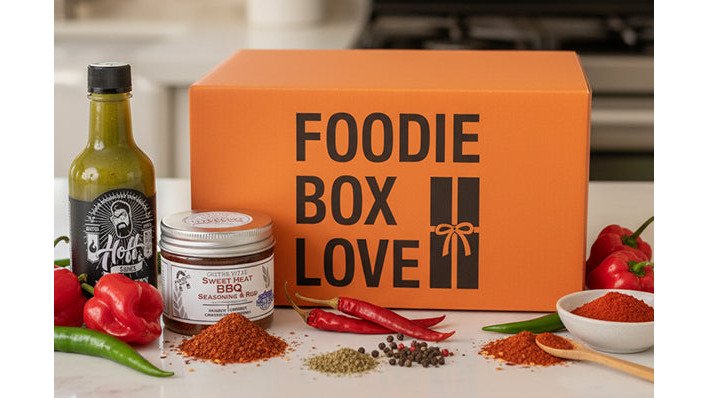
Each box includes artisan vendor background plus tips and recipes, so you're not left guessing how to use a bottle of fermented pepper mash.
Best for: Anyone who already keeps three or more hot sauces in the fridge and wants to go deeper. Watch out for: If you prefer mild food, this box will overwhelm your cooking rather than enhance it.
Drizzle & Drip: Best for Finishing Oils and Vinegars
Drizzle & Drip targets the finishing end of cooking, with three artisan bottles or jars plus samples for $60.00.

The curation leans toward a balanced extra-virgin olive oil, a barrel-aged balsamic, and a crunchy chili crisp. These are the bottles you reach for after the heat is off: a drizzle over a sizzling steak, a drip across crusty bread, a spoonful stirred into toast.
What most guides miss: finishing oils and vinegars have a shorter useful window than sauces. You'll use them faster once they're on the counter rather than in a cabinet.
Best for: Home cooks who want to elevate simple dishes without learning new techniques. Watch out for: If you rarely cook with oil or vinegar beyond basic sautéing, this box will outpace your usage.
Chef's Companion: Best for Full Pantry Staples
At $115.00, Chef's Companion is the most substantial box in the lineup, delivering five to six artisan pantry items designed to power full meals rather than garnish them.
Selections have included a balanced extra-virgin olive oil, truffle sea salt, bronze-cut pasta, roasted-garlic tomato sauce, a smoky paprika blend, and sun-dried tomato pesto. This is for someone building a pantry around specialty food rather than treating it as an occasional splurge.
The trade-off is commitment: five to six items per delivery is a lot to work through before the next box, especially cooking for one or two.
Best for: Households that cook most nights and want a rotating supply of gourmet condiments and staples. Watch out for: Storage space. Six bottles and jars add up fast.
The Foodie Sampler: Best for Trying Before Committing
The Foodie Sampler answers the most common objection we hear: how do you know you'll like the curation before committing to a full box? At $40.00, it delivers four to six products drawn from the monthly boxes, plus one to two sample surprises.
Past assortments have included a classic medium-roast coffee, bronzed-cut pasta, a bright tomato vodka sauce, honey-roasted nuts, a chili crisp, and a balanced extra-virgin olive oil. It's a genuine cross-section rather than a themed set, the right call if you're gifting and unsure where the recipient's tastes land.
Best for: Gift-givers and first-time subscribers testing the waters. Watch out for: Less thematic coherence than the other three boxes.
Best Artisan Food Subscription Boxes 2026: Comparison Table
| Box | Price | What's Inside | Best For | Shipping |
|---|---|---|---|---|
| Hot & Spicy | $45.00 | 3 artisan hot and spicy products + 1-2 samples | Heat seekers building a sauce collection | Free |
| Drizzle & Drip | $60.00 | 3 artisan bottles or jars + 1-2 samples | Finishing oils, vinegars, and chili crisp | Free |
| Chef's Companion | $115.00 | 5-6 artisan pantry items + 1-2 samples | Full pantry staples for frequent cooks | Free |
| The Foodie Sampler | $40.00 | 4-6 products from monthly boxes + 1-2 samples | Gifting and trying before committing | Free |
Every box includes an optional personalized gift message and background on each artisan vendor. Flexible gifting options run 1, 3, 6, or 12 months, which matters if you're sending a gift subscription rather than subscribing for yourself.
Gourmet Hot Sauce of the Month Club: What to Expect
A gourmet hot sauce of the month club delivers recurring shipments of limited-run sauces, typically monthly or quarterly, each box curated around a theme or heat range. The best include producer background and recipes; the weakest ship bottles with no context. But what determines whether a club is worth a year of your money comes down to three things most reviews skip: dietary filtering, shipping footprint, and what happens after month six.
The Standard Mechanics
A typical month with a well-run club:
- Delivery frequency: Monthly by default, with quarterly options for slower consumption
- Bottle size: Standard artisan sizes, typically 5-10 oz, smaller than mass-market 12-17 oz bottles
- Curation: Rotating themes, so you don't get the same flavor profile twice
- Extras: Sample surprises, recipe cards, and vendor stories
- Billing: Recurring, cancellable between shipments
Dietary Restriction Filtering: The Gap Most Reviews Ignore
If you're vegan, keto, gluten-free, or watching sodium, a hot sauce club can quietly become useless. How to filter before subscribing:
- Vegan: Most chili-based hot sauces are naturally vegan, but watch for honey-sweetened glazes, fish sauce in Thai-style sauces, and anchovy in Worcestershire-based BBQ blends.
- Gluten-free: Distilled vinegar is generally gluten-free, but some producers use malt vinegar or soy sauce (which contains wheat) in Asian-style sauces. Check the panel, not the category.
- Keto / low-sugar: Fruit-forward sauces (mango habanero, pineapple, sweet chili) can carry 4-8 g of sugar per teaspoon. If you're tracking carbs, request the nutrition panel before your first shipment.
- Low-sodium: Hot sauce is often a sodium bomb. Some small-batch producers offer no-salt-added versions; most don't. If sodium is a concern, this is a dealbreaker category.
- Tree nut and sesame: Chili crisp frequently contains peanuts, and sesame oil is common in Asian-style sauces (PubMed). Both are now labeled major allergens in the U.S., so the panel will tell you.
Small-batch producers often use shared equipment. A "may contain" allergen statement isn't marketing hedging, it's a real cross-contact risk. If you have a severe allergy, confirm dedicated production lines before subscribing.
Sustainability: What Monthly Glass Shipping Actually Costs
Glass bottles and jars are recyclable, but shipping weight adds up fast. A typical monthly box of four to six glass jars adds 4-8 lb per delivery, roughly 50-100 lb of glass a year moving through the parcel network, most of it protective packaging you'll discard immediately.
Three ways to cut the footprint without giving up variety:
- Switch to quarterly delivery. Same total volume, one-third the shipments and packaging.
- Favor boxes that consolidate. A single larger shipment beats three small ones on every environmental metric.
- Reuse, don't just recycle. Small-batch jars are ideal for spice blends, homemade dressings, and pantry decanting.
Long-Term Retention: What Six Months Actually Looks Like
Most reviews are first impressions. The more useful question: what happens by month six? A few patterns hold across long-term subscribers:
- Subscribers who cook with the box within the first week stay far longer than those who shelve it. Recipe integration is the difference between a habit and a cancellation after two months.
- Repeat flavors are the #1 cancellation trigger. If the same smoky chipotle profile shows up three months running, the box stops feeling curated.
- Quarterly beats monthly for most households. Unless you cook with hot sauce daily, a monthly box outpaces consumption and bottles pile up.
- Gift subscriptions rarely convert to self-subscriptions unless the recipient already cooks with specialty ingredients. The box must fit an existing habit, not create one.
Recipe Integration: The Underrated Value Driver
The single biggest predictor of long-term satisfaction is whether the box helps you use what's inside. A bottle of fermented pepper mash with no context becomes a decoration; the same bottle with a recipe for a 10-minute chili crisp noodle bowl becomes a weeknight staple. When comparing clubs, weigh recipe and vendor-story extras as heavily as bottle count, they turn a shipment into a habit.
Frequently Asked Questions
Which cooking subscription box is the best for artisan sauces?
The best option depends on your cooking style. For heat-focused cooks, a box like Hot & Spicy ($45) delivers three artisan hot sauces plus samples. If you prefer finishing oils and vinegars, Drizzle & Drip ($60) offers three bottles plus surprises. Chef's Companion ($115) suits those who want five to six pantry staples. All include free shipping and artisan background stories. Start with The Foodie Sampler ($40) if you want to try before committing to a full box.
Is a sauce subscription box worth the monthly cost?
It depends on how often you cook with specialty ingredients. A small batch sauce subscription box typically costs $40 to $115 per delivery. If you use the products regularly, the per-bottle cost often beats buying individual artisan items at retail. The real value comes from discovering makers you would not find locally and getting recipe ideas. If you cook with sauces a few times a week, a subscription makes sense. If you rarely experiment, a one-time sampler is a smarter first step.
What makes a sauce 'small batch' compared to store-bought brands?
Small-batch sauces are made in limited runs by independent producers, often using traditional methods like fermentation or slow cooking. Unlike mass-produced brands, small-batch makers focus on ingredient sourcing and unique chili pepper varieties. You will often see pepper mash, vinegar-based recipes, or fermented sauces rather than preservative-heavy formulas. This means more complex flavor profiles and less consistency between batches, which many enthusiasts consider a feature, not a flaw.
How do I choose the right gourmet hot sauce of the month club for my palate?
Start by identifying your heat tolerance using Scoville heat units as a guide. If you enjoy mild to medium heat, look for boxes that include chipotle or sweet chili glazes. For serious heat, choose a box focused on Calabrian chili or habanero. Also consider whether you want only hot sauces or a mix of condiments. Check the cancellation policy and shipping frequency before subscribing. Check the cancellation policy and shipping frequency before subscribing.
Can I send a small batch sauce subscription box as a gift?
Yes, most artisan food subscription boxes offer gift options. Foodie Box Love, for example, provides flexible gifting for 1, 3, 6, or 12 months with an optional personalized gift message. The recipient gets free shipping on every box. If you are unsure about their preferences, start with a one-time sampler like The Foodie Sampler ($40) so they can explore before you commit to a longer subscription. Check whether the service allows customization for dietary restrictions before ordering.