

How to Use Artisan Infused Oils: A 2026 Guide
Table of Contents
- What Makes Artisan Infused Oils Different
- How to Cook with Flavored Olive Oil
- Best Artisan Infused Oil Pairings for Every Dish
- How to Store Artisan Infused Oils
- Food Safety: Preventing Botulism in Infused Oils
- Troubleshooting Cloudy, Separated, or Rancid Oils
- Where to Find Quality Artisan Infused Oils
- Frequently Asked Questions
Last Updated: September 11, 2026
What Makes Artisan Infused Oils Different
Artisan infused oils are small-batch oils flavored by steeping herbs, spices, citrus, or aromatics rather than industrial processing. At Foodie Box Love, we've watched home cooks save these bottles for a "special occasion" that never arrives. That's a mistake, a well-made infused oil turns an ordinary Tuesday dinner into something worth talking about.
The difference starts with the base. Most artisan producers begin with cold-pressed extra virgin olive oil or a neutral oil, then add flavor slowly with real ingredients instead of laboratory extracts. That's why the good stuff costs more and tastes nothing like supermarket flavored oils.
Fused vs. Infused: Why It Matters
Fused oil is made by crushing flavoring ingredients together with the olives during milling, so the flavor is built into the oil itself. Infused oil is made by steeping ingredients in already-pressed oil, which extracts flavor over time.
The distinction matters twice over. Fused oils taste more integrated and subtle, while infused oils taste brighter and more forward. Fused oils are also more shelf-stable, because the flavoring material never sat in the finished oil. Labels rarely spell this out: if the ingredient list names olives and the flavoring as co-milled, it's fused; if it lists the oil first and the flavoring second, it's infused.
How to Cook with Flavored Olive Oil
Treat flavored olive oil as a finishing ingredient first and a cooking fat second. Heat dulls delicate aromatics, so the flavor you paid for is the flavor you lose in a screaming hot pan.
Here's how to get the most from a bottle:
- Drizzle raw over salads, soups, grains, and roasted vegetables right before serving
- Finish cooked dishes with a quick swirl after the heat is off
- Use as a marinade base for chicken, fish, or vegetables, where the oil has time to work at room temperature
- Blend into dips like hummus or whipped feta for instant depth
- Brush onto bread before toasting for a fast, impressive appetizer
- Spoon over cold dishes like burrata, tomatoes, or chilled beans, where the oil is the sauce
A common mistake is using a $30 bottle of truffle-infused oil like an $8 bottle of cooking oil. Reserve the good stuff for moments where you'll actually taste it.
Smoke Point and Heat: What to Know
Most infused olive oils have a moderate smoke point, lower than refined oils but high enough for gentle sautéing. Flavoring ingredients, especially garlic, chili, or citrus peel, can lower it further and turn the oil bitter if overheated. Smoke point also drops as oil degrades, and infused oils start with a handicap: steeping introduces trace moisture and suspended plant solids (herb particles, chili flakes, citrus oils) that burn before the oil itself, so a garlic-infused oil can smoke at a lower temperature than the same base oil used plain.
A practical temperature guide for the home kitchen:
| Use Case | Target Pan Temperature | Why |
|---|---|---|
| Raw drizzle / finishing | No heat | Preserves volatile aromatics |
| Salad dressing / marinade | Room temperature | Full flavor extraction, no degradation |
| Gentle sauté (eggs, soft vegetables) | 250-300°F | Below most infused oil smoke points |
| Medium sauté (onions, mushrooms) | 300-350°F | Watch for shimmer; pull back if acrid |
| High-heat sear | Use neutral oil instead | Infused oil will burn and turn bitter |
The practical rule: keep infused oils below their smoke point and use them for medium heat at most. If the oil shimmers aggressively or smells acrid, you've gone too far. For high-heat searing, use neutral oil and save the infused bottle for the plate.
One nuance: chili oils often contain added garlic or shallot, which are the real smoke-point limiters, not the chili. If your chili oil smokes early, it's usually the alliums. Strain them out if you plan to cook with it.
Pairing by Flavor Profile
| Flavor Profile | Best Paired With | Avoid |
|---|---|---|
| Herb (rosemary, basil, thyme) | Roasted potatoes, white beans, grilled chicken | Delicate fish, fruit desserts |
| Citrus (lemon, orange) | Seafood, salads, steamed vegetables | Red meat, heavy cream sauces |
| Chili or pepper | Pizza, pasta, eggs, grilled steak | Mild white fish, sweet baked goods |
| Garlic | Bread, pasta, roasted vegetables, marinades | Anything you want to taste subtly |
| Truffle or mushroom | Risotto, eggs, potatoes, pasta | Light salads, citrus dishes |
A quick example: a rosemary-infused oil over roasted fingerling potatoes with flaky salt is one of the simplest, most impressive sides you can make. A lemon-infused oil drizzled over seared scallops needs nothing else.

Matching Intensity to the Dish
The pairing table works because of one rule: match the oil's intensity to the dish's intensity. A delicate lemon oil disappears under a heavy steak; a bold chili oil overwhelms a light white fish. Get the match right and the oil does the work of a sauce. preserving artisanal sauces.
Here's how to think about intensity in practice:
- Delicate oils (lemon, basil, tarragon, fennel) work best as a finishing drizzle on mild proteins and vegetables. Use about 1 teaspoon per serving.
- Medium oils (rosemary, thyme, sage, garlic) can carry a whole dish. Use 1-2 teaspoons per serving, or 2-3 tablespoons for a pound of vegetables.
- Bold oils (chili, truffle, smoked paprika, black garlic) should be used sparingly, 1/2 teaspoon per serving is often enough. These oils are closer to a condiment than a cooking fat.
For dressings, use 3 parts oil to 1 part acid (vinegar or citrus juice), plus a pinch of salt. Bold oils may need more acid to stay balanced, try 2 parts oil to 1 part acid for chili or truffle oils. For proteins, drizzle after cooking, not before: a grilled chicken breast finished with rosemary oil tastes more intensely of rosemary than one marinated in it, because heat hasn't driven off the volatile compounds. For bread and starches, infused oil substitutes directly for butter, brush it on focaccia before baking, or whisk it into mashed potatoes in place of some butter.
Common Pairing Mistakes
- Using truffle oil on seafood. Truffle's earthy, pungent notes clash with delicate fish. Save it for eggs, potatoes, and pasta.
- Pairing citrus oil with red meat. The acid in citrus oils can make red meat taste metallic. Use herb or chili oils instead.
- Drizzling chili oil on a mild white fish. The heat overwhelms the fish. Use a lemon or herb oil, and add chili at the table if you want heat.
- Using garlic oil on everything. Garlic is a strong flavor. It works on bread, pasta, and roasted vegetables, but it flattens more subtle dishes.
- Forgetting salt. Infused oils are not salted. A pinch of flaky salt on top of a drizzle makes the flavor pop.
A Simple Pairing Framework
If you only remember one thing from this section, remember this three-step framework:
- Identify the dominant flavor of the dish. Is it mild (fish, eggs, steamed vegetables) or bold (steak, roasted roots, aged cheese)?
- Choose an oil one notch below the dish's intensity. A bold dish can handle a medium oil; a mild dish needs a delicate oil.
- Add the oil at the end. Finishing oils are called that for a reason, they're the last thing on the plate, not the first thing in the pan.
This framework works for any infused oil, whether it's a $12 bottle from the grocery store or a $40 small-batch bottle from a specialty maker. The oil doesn't know its price. It only knows how you use it.
Best Artisan Infused Oil Pairings for Every Dish
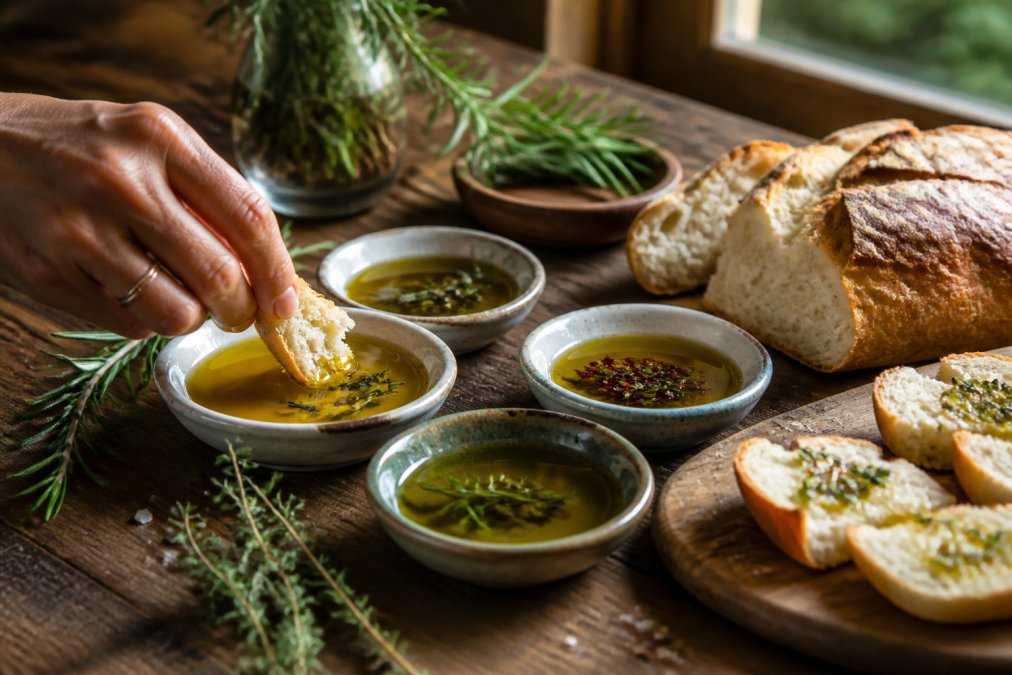
Pairing by Flavor Profile
| Flavor Profile | Best Paired With | Avoid |
|---|---|---|
| Herb (rosemary, basil, thyme) | Roasted potatoes, white beans, grilled chicken | Delicate fish, fruit desserts |
| Citrus (lemon, orange) | Seafood, salads, steamed vegetables | Red meat, heavy cream sauces |
| Chili or pepper | Pizza, pasta, eggs, grilled steak | Mild white fish, sweet baked goods |
| Garlic | Bread, pasta, roasted vegetables, marinades | Anything you want to taste subtly |
| Truffle or mushroom | Risotto, eggs, potatoes, pasta | Light salads, citrus dishes |
A quick example: a rosemary-infused oil over roasted fingerling potatoes with flaky salt is one of the simplest, most impressive sides you can make. A lemon-infused oil drizzled over seared scallops needs nothing else.
How to Store Artisan Infused Oils
Storing artisan infused oils comes down to three enemies: heat, light, and air. Keep bottles in a cool, dark cabinet away from the stove, tightly capped, and use them within their recommended window.
Light degrades oil faster than almost anything else, which is why quality producers use dark glass. If your bottle came in clear glass, transfer it to a dark container or keep it in a closed cabinet.
Shelf Life and Refrigeration
Most commercially made infused oils are shelf-stable for several months when stored properly. Refrigeration isn't required but can extend freshness; expect the oil to thicken or cloud slightly, which is normal and reverses at room temperature.
Homemade infused oils are a different story. Any oil infused with fresh garlic, fresh herbs, or fresh produce must be refrigerated and used within about a week (the CDC). This isn't optional, it's the single most important storage rule in this guide.
Food Safety: Preventing Botulism in Infused Oils
Botulism is why food safety rules for infused oils are stricter than for almost any other pantry item. Clostridium botulinum spores can survive in oil, which provides the oxygen-free environment they need to produce toxin. The risk is real and entirely preventable.
The core principle: botulism bacteria need moisture, low acid, and no oxygen. Oil supplies the no-oxygen part, so the fix is to remove moisture and acidify where possible.
Why Fresh Garlic and Herbs Are the Real Risk
The botulism risk comes almost entirely from fresh ingredients, not the oil itself:
- Fresh garlic, herbs, and chili carry surface moisture and soil-borne spores. When submerged in oil, that moisture creates tiny pockets where spores can germinate.
- Dried ingredients have had their moisture removed, so they can't support spore germination. This is why dried garlic, dried chili, and dried herbs are considered safe for room-temperature infusion.
- Acid lowers the pH below the threshold where C. botulinum can grow. Soaking fresh ingredients in vinegar or lemon juice before adding them to oil reduces the risk, though it doesn't eliminate it entirely.
The practical takeaway: for a shelf-stable infused oil, use dried ingredients. For fresh ingredients, refrigerate the oil and use it within a week.
A Decision Framework for Home Infusers
Use this framework to decide whether a homemade infused oil is safe to store at room temperature:
| Ingredient Type | Room-Temperature Safe? | Refrigeration Required? | Max Storage |
|---|---|---|---|
| Dried herbs and spices | Yes | No | 2-3 months |
| Dried garlic or onion | Yes | No | 2-3 months |
| Dried chili flakes | Yes | No | 2-3 months |
| Fresh garlic | No | Yes | 1 week |
| Fresh herbs | No | Yes | 1 week |
| Fresh chili | No | Yes | 1 week |
| Fresh citrus peel | No | Yes | 1 week |
| Fresh ginger | No | Yes | 1 week |
If your ingredient is fresh, the oil goes in the fridge and gets used within a week. No exceptions.
Step-by-Step Safety Protocol
Follow these food safety protocols:
- Choose your ingredients. Dried for shelf-stable, fresh for refrigerator-only.
- Sanitize your jars and bottles. Wash with hot soapy water, rinse, and dry completely. Any residual water is a botulism risk.
- Acidify fresh ingredients if using them. Soak in vinegar or lemon juice for 10-15 minutes, then pat dry before adding to oil. This lowers surface pH.
- Cover ingredients completely with oil. Exposed ingredients can grow mold.
- Refrigerate any oil made with fresh ingredients. Use within one week.
- Label with the date. You will not remember when you made it.
- Discard any oil that smells off, looks cloudy in a new way, or has visible growth.
What Commercial Producers Do Differently
Commercial producers follow established food safety protocols, which is why their oils are shelf-stable. The key differences:
- Commercial producers use dried or acidified ingredients in most shelf-stable products.
- They test for water activity and pH to confirm the product won't support bacterial growth.
- They use controlled heat treatment during infusion to reduce microbial load.
- They package in dark glass to slow oxidation and extend shelf life.
That's why a commercial garlic-infused oil sits on a shelf for months while your homemade version needs refrigeration. The commercial product isn't magic, it's engineered for safety.
When to Throw It Out
Err on the side of caution. Discard the oil if:
- It has been stored at room temperature with fresh ingredients for more than a few hours
- It smells rancid, sour, or like old crayons
- It has visible mold, cloudiness at room temperature, or separated layers
- It has been in the fridge for more than a week (for fresh-ingredient oils)
- You can't remember when you made it
A discarded bottle costs a few dollars; botulism costs a hospital stay. The math is easy.
For commercial infused oils, producers follow established food safety protocols, which is why they're shelf-stable. For home infusions, the USDA guidance on home food preservation and botulism is the place to check before you experiment.
Troubleshooting Cloudy, Separated, or Rancid Oils
Cloudy oil isn't automatically bad. Olive oil and many infused oils cloud naturally when cold and clear as they warm. Cloudiness that persists at room temperature usually signals moisture in the bottle.
Separation is more serious. Distinct layers mean water got in, which is a botulism risk, discard the bottle rather than trying to salvage it.
Rancidity is easiest to spot: oil smells like old crayons, stale nuts, or a sour, paint-like odor, and tastes flat and bitter. Once rancid, there's no fixing it. Toss it.
A quick diagnostic table:
| Symptom | Likely Cause | Action |
|---|---|---|
| Cloudy when cold, clears when warm | Normal temperature response | Use as normal |
| Cloudy at room temperature | Moisture in the bottle | Discard |
| Visible separated layers | Water contamination | Discard |
| Crayon or stale-nut smell | Rancidity | Discard |
| Bitter taste after cooking | Overheated past smoke point | Use raw only |
Where to Find Quality Artisan Infused Oils
Finding oils worth the shelf space is easier when someone else has done the sourcing. Foodie Box Love curates small-batch oils, vinegars, and pantry items from makers who care how the oil was made, not just how the bottle looks. The Drizzle & Drip box is built around finishing oils and drizzles designed to be the last thing you add to a dish, not the first.

If you want a broader starting point, the Chef's Companion box includes five to six artisan pantry items for cooking through the week, and the Taste the Mediterranean box leans into bright, coastal flavors that pair naturally with citrus and herb oils. For cooks who want to experiment with bolder profiles, the Taste of Asia box brings sauces and condiments that work alongside chili and sesame oils.

Most home cooks never get past the first drizzle because they're afraid of "using it wrong." Artisan infused oils reward experimentation more than precision. Start with one bottle, drizzle it over something you already cook, and taste the difference. When you're ready for a curated selection without guessing at the store, Foodie Box Love makes it simple with hand-picked small-batch oils, flexible gift options, and free nationwide delivery. Get started with Foodie Box Love and turn tonight's dinner into something worth remembering.
Frequently Asked Questions
What are some ways to use infused oils?
Use infused oils for drizzling over salads, finishing soups, marinating meats, dipping bread, and emulsifying vinaigrettes. Try basil oil on caprese, chili oil on pizza, or lemon oil on grilled fish. They also work well in marinades and as a finishing oil for roasted vegetables. Start with a small amount and adjust to taste.
How to avoid botulism in infused oils?
Botulism risk comes from fresh garlic, herbs, or vegetables in oil. To stay safe, use dehydrated herbs, acidify with lemon juice or vinegar, and refrigerate. If you infuse with fresh garlic, store in the fridge and use within 4 days. Never leave homemade fresh-infused oil at room temperature.
Do I need to refrigerate infused oil?
If you made oil at home with fresh garlic or herbs, refrigeration is mandatory. Check the label: some oils solidify in the fridge, so let them sit at room temperature for 10 minutes before use.
Can you cook with infused oils or are they only for finishing?
You can cook with infused oils, but heat affects flavor. Use them for sautéing at medium heat, roasting vegetables, or baking. For high-heat searing, choose oils with a high smoke point like avocado or refined olive oil. Delicate oils like truffle or basil are best as finishing oils added after cooking to preserve their aroma.