
How to Identify High Quality Artisan Food
Table of Contents
- What You'll Need to Evaluate Artisan Food
- Start With the Ingredient List: How to Read Food Labels for Quality
- Artisan vs Mass-Produced Food Comparison: What Changes at Scale
- What to Look For in Artisan Sauces and Oils
- Use Your Senses: A Sensory Evaluation Checklist
- Check Certifications and Verify the Producer
- Storage and Shelf-Life Indicators
- Common Mistakes When Buying Artisan Food
- Frequently Asked Questions
Last Updated: September 13, 2026
What You'll Need to Evaluate Artisan Food
You do not need a lab coat to judge artisan food, but you do need a few tools and habits. Identifying high quality artisan food starts with three things: reading the whole label, a basic sensory routine, and verifying who actually made the product. At Foodie Box Love, we feature small-batch oils, sauces, and pantry staples from independent makers every month.

Here is what to gather before you shop:
- A phone for checking producer websites and certification databases
- A notebook or notes app for tracking producers you trust
- A neutral palate (skip coffee and strong flavors for 30 minutes before tasting)
- A clean spoon and small cup for tasting oils and sauces
- The product's label, photographed, for comparing future batches
Most buyers skip verification entirely. This guide fills that gap: not just what artisan food is, but how to confirm the premium price is earned.
Start With the Ingredient List: How to Read Food Labels for Quality
The ingredient list is the fastest quality test. A high-quality artisan product usually lists few recognizable ingredients, with no artificial additives or preservatives standing in for freshness.
Read the list in this order:
- Count the ingredients. Short lists (five to eight items) suggest a maker relying on technique rather than additives.
- Check the order. Ingredients appear by weight, so if sugar or a cheap oil leads the list, flavor is being built on filler.
- Look for named sources. "California olive oil" or "Vermont maple syrup" tells you more than "vegetable oil blend."
- Scan for gums, colors, and stabilizers. Xanthan gum, artificial colors, and "natural flavor" are common in mass-produced food and rare in small-batch work.
Red Flags on a Label
Certain phrases should slow you down. "Artisan-style," "gourmet," and "crafted" are marketing terms with no legal definition, so they prove nothing on their own. Vague origin claims ("imported," "premium blend") and unverifiable health claims are also worth a second look. The FDA food labeling guidance sets the rules for what must appear on a label, including ingredient statements and allergen declarations; anything beyond that is voluntary storytelling.
Artisan vs Mass-Produced Food Comparison: What Changes at Scale
Scale changes almost everything. Small-batch manufacturing lets a maker adjust by hand, source seasonal raw materials, and accept batch variation as a sign of real ingredients. Mass production optimizes for consistency, shelf stability, and cost, meaning standardized inputs and added preservatives.
| Factor | Artisan / Small-Batch | Mass-Produced |
|---|---|---|
| Ingredients | Few, often locally-sourced | Longer lists, stabilizers |
| Batch consistency | Varies slightly batch to batch | Engineered to be identical |
| Production scale | Small-scale manufacturing | High-volume lines |
| Preservation | Relies on acid, salt, or heat | Often chemical preservatives |
| Traceability | Producer usually named | Often anonymous supply chain |
Batch Consistency vs Batch Variation
Perfectly identical jars every time can be a warning sign. Real heirloom ingredients and traditional methods produce slight shifts in color, texture, and aroma between batches.
What to Look For in Artisan Sauces and Oils
Freshness and traceability matter most here. For oils, look for a harvest date rather than a "best by" date, dark glass or tinted bottles, and a single named origin. For sauces, look for a clean ingredient list, a visible producer name, and a stated production method like fermentation or slow-cooking.
Quick checks:
- Olive oil: harvest date within the last 18 months, single region, peppery finish
- Vinegar: "mother" present or aged in wood, no caramel color
- Chili crisp or hot sauce: named peppers, no artificial thickeners
- Tomato sauce: tomatoes listed first, no added sugar high in the list
Use Your Senses: A Sensory Evaluation Checklist
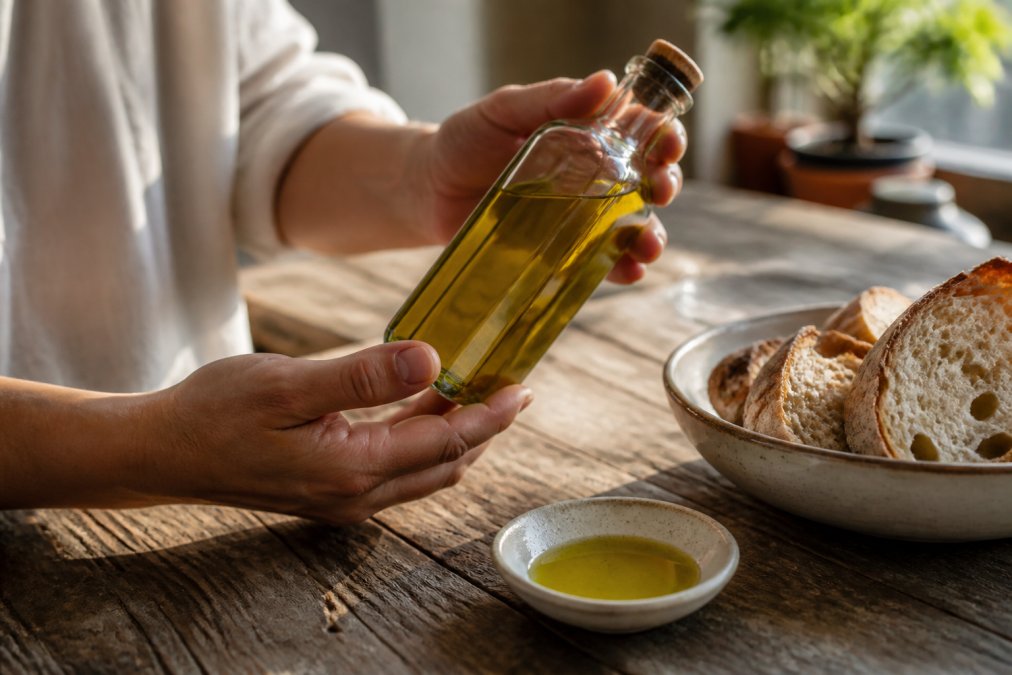
Labels tell you what a maker claims; your senses tell you what actually happened in the jar.
Set Up a Fair Test
Sensory evaluation fails when conditions are wrong. Before tasting:
- Skip coffee, citrus, mint, and anything spicy for at least 30 minutes; these coat the palate and mute subtle flavors.
- Use a clean glass or ceramic spoon and a small cup; metal can throw a metallic note into oils and vinegar.
- Taste at room temperature. Cold mutes aroma compounds, which is why refrigerated olive oil tastes flat until it warms.
- Taste one product at a time, rinsing with plain water or neutral bread between samples.
- Taste the same product across two batches if you can; batch differences are your most useful signal.
Work Through the Senses in Order
Evaluate in this sequence, because each step primes the next:
- Aroma first. Swirl and smell before tasting. Fresh olive oil smells grassy, peppery, or like artichoke; rancid oil smells like crayons, putty, or old nuts. Vinegar should smell sharp and clean, not like nail polish remover (over-oxidation).
- Appearance second. Natural color variation is normal, olive oil ranges from green to gold by harvest and varietal. Not normal: a cloudy layer that will not recombine when shaken, or a bright, uniform color that looks engineered.
- Texture third. A good sauce or preserve coats a spoon evenly. Gritty, chalky, or slimy textures usually mean stabilizers, over-processing, or a product past its window.
- Taste fourth. Flavor should arrive in layers, an initial note, a middle, and a finish. A single flat hit of salt, sugar, or acid signals a product built on additives rather than ingredients.
- Finish last. A clean finish fades; a metallic, soapy, or rancid edge lingers.
What Specific Defects Actually Taste Like
Knowing the vocabulary makes you a faster judge:
- Rancidity in oils and nuts: crayon, putty, or stale cardboard, caused by oxidation, light and heat accelerate it.
- Over-acidity in vinegar or fermented sauces: a harsh, burning sharpness hitting the back of the throat rather than a rounded tang.
- Flatness in preserves: sweetness with no fruit character, usually from added sugar or syrup outrunning the fruit.
- Metallic or soapy notes in oils: often from poor filtration or storage in reactive containers.
- Grittiness in nut butters or stone-ground products: sometimes authentic (unfiltered), sometimes cheap filler. Ask the maker which.
Score Before You Decide
Give each product a pass/fail on the five senses.
Check Certifications and Verify the Producer
Certifications are only useful if you verify them. Artisan-washing, dressing up a mass-produced product in small-batch language, can occur. A short verification routine can help before you pay a premium.
Certifications That Actually Mean Something
Some labels are backed by law and third-party inspection. Others are pure marketing. The ones worth checking:
- USDA Organic. Producers must meet the USDA National Organic Program standards, and you can confirm a specific operation through the USDA Organic Integrity Database.
- Non-GMO Project Verified. A third-party verification with a searchable product database. The claim is specific and checkable.
- Certified Fair Trade (Fair Trade USA, Fairtrade America). Verifiable through the certifying body's producer listings.
- Protected Designation of Origin-style claims. For imported goods, terms like Parmigiano-Reggiano or Champagne are legally protected in their home markets. Domestic producers cannot legally use those names on comparable products, so a domestic cheese labeled "parmesan-style" is being honest.
Buzzwords With No Legal Teeth
The FDA food labeling guidance sets the rules for what must appear on a label, ingredient statements, allergen declarations, net weight, and nutrition facts. Everything else on the front of the package is voluntary storytelling. These terms carry no legal definition and prove nothing on their own:
- "Artisan," "artisanal," "artisan-style"
- "Gourmet," "craft," "crafted," "handcrafted"
- "Small-batch," "small-batch made," "made in small batches"
- "Premium," "premium blend," "chef-inspired"
- "Natural" (the FDA has a loose policy on this, but it is not a certification)
None of these are illegal. They are simply unverifiable, which means the burden of proof falls on you.
How to Detect Artisan-Washing
Mass-produced brands often borrow artisan language while keeping industrial sourcing. Watch for these combinations:
- Small-batch claim + nationwide big-box distribution. Genuine small-batch producers usually cannot supply every major retailer at once. If the product is in every chain, ask how "small" the batch really is.
- Named ingredient + unnamed producer. "California olive oil" is a start, but who grew it? If the brand cannot name the farm, mill, or co-op, the sourcing claim is thin.
- Beautiful packaging + vague label. A gorgeous box with no physical address, production date, or named maker is a red flag, not a gift.
- Story-heavy website + no certifications.
- "Imported" with no origin. Imported from where, by whom, under what standards? If the label will not say, assume the cheapest answer.
A Five-Minute Verification Routine
Run this before you buy from a new producer:
- Find the physical address. A real producer has one. A P.O. box alone is not disqualifying, but it is a prompt to dig further.
- Search the certification databases. USDA Organic, Non-GMO Project, and Fair Trade USA all have public lookups.
- Check the producer's site for a named farm, mill, or co-op. Specificity is the tell.
- Look for a production or harvest date on the package. A "best by" date alone tells you nothing about when the product was made.
- Message the producer with one specific question. "Where were the olives for this batch grown, and when were they pressed?"
Storage and Shelf-Life Indicators
Shelf life is a clue about what is inside. Products that keep for years without refrigeration often rely on preservatives, while fresh small-batch items usually carry a shorter window and clear storage instructions.
Watch for these indicators:
- A printed harvest or production date, not just a "best by"
- Storage guidance that matches the product (refrigerate after opening, keep out of light)
- A shorter shelf life than the mass-market equivalent
- Any sign of separation, off-smell, or color shift after opening, which means it is time to let it go
Common Mistakes When Buying Artisan Food
The most expensive mistake is paying for packaging instead of product. A beautiful box with a vague label and no named producer can be a red flag.
Other frequent errors:
- Trusting "artisan-style" or "gourmet" as quality claims
- Ignoring the ingredient list because the front of the package looks premium
- Assuming a higher price guarantees better quality without verification
- Never tasting side by side, which makes it hard to notice real differences
- Buying only for shelf life and missing fresher, better-made options
Treating artisan food as a one-time splurge rather than a relationship is another common mistake.
Judging artisan food well comes down to a repeatable habit: read the label, taste with intention, and verify the maker behind the product. That is the standard we hold at Foodie Box Love, where every box features small-batch products from makers we have vetted, with flexible gift options for 1, 3, 6, or 12 months and nationwide free delivery. Explore our hand-curated artisan food gift boxes and gourmet subscription boxes to discover new artisan brands each month, and get started with Foodie Box Love to turn everyday meals into something worth savoring.
Frequently Asked Questions
How can I tell if a food product is truly artisan or mass-produced?
Check the ingredient list first. Artisan food typically lists recognizable ingredients without artificial additives or preservatives. Look for batch numbers or production dates, which indicate small-batch manufacturing. Mass-produced items often have long shelf lives and uniform packaging. Also research the producer: artisan makers usually share their story, sourcing practices, and traditional methods. If the brand cannot tell you who made it or where ingredients came from, it is likely mass-produced.
What should I look for on a food label to verify quality?
Start with the ingredient list: fewer ingredients is generally better. Look for specific terms like cold-pressed, bronze-cut, or aged rather than vague words like natural or gourmet. Check for organic certification seals if that matters to you. Look for a batch code or best-by date that suggests freshness. Avoid products with artificial additives, preservatives, or high-fructose corn syrup. The label should also list the producer or manufacturer, not just a distributor.
Are there specific certifications for artisan food products?
Yes. The USDA Organic seal verifies organic farming and processing standards. For some products, you may see Non-GMO Project Verified, Fair Trade Certified, or specific state-level artisan food certifications. However, no single certification defines artisan food. Use certifications as one signal alongside ingredient lists, production methods, and producer transparency. Be wary of unverified claims like artisan-style or handmade without supporting details.
How does small-batch production impact the quality of food?
Small-batch production allows makers to control each step more closely. They can source better raw materials, adjust recipes based on seasonal ingredients, and catch defects early. This often results in more complex flavors and better texture. Batch consistency may vary slightly from one run to the next, which is normal for handcrafted products. Mass-produced food prioritizes uniformity and shelf life, often at the expense of flavor depth. Small-batch also supports local economies and traditional methods.